
What Event Management Steps Are Followed to Create a Successful Event?
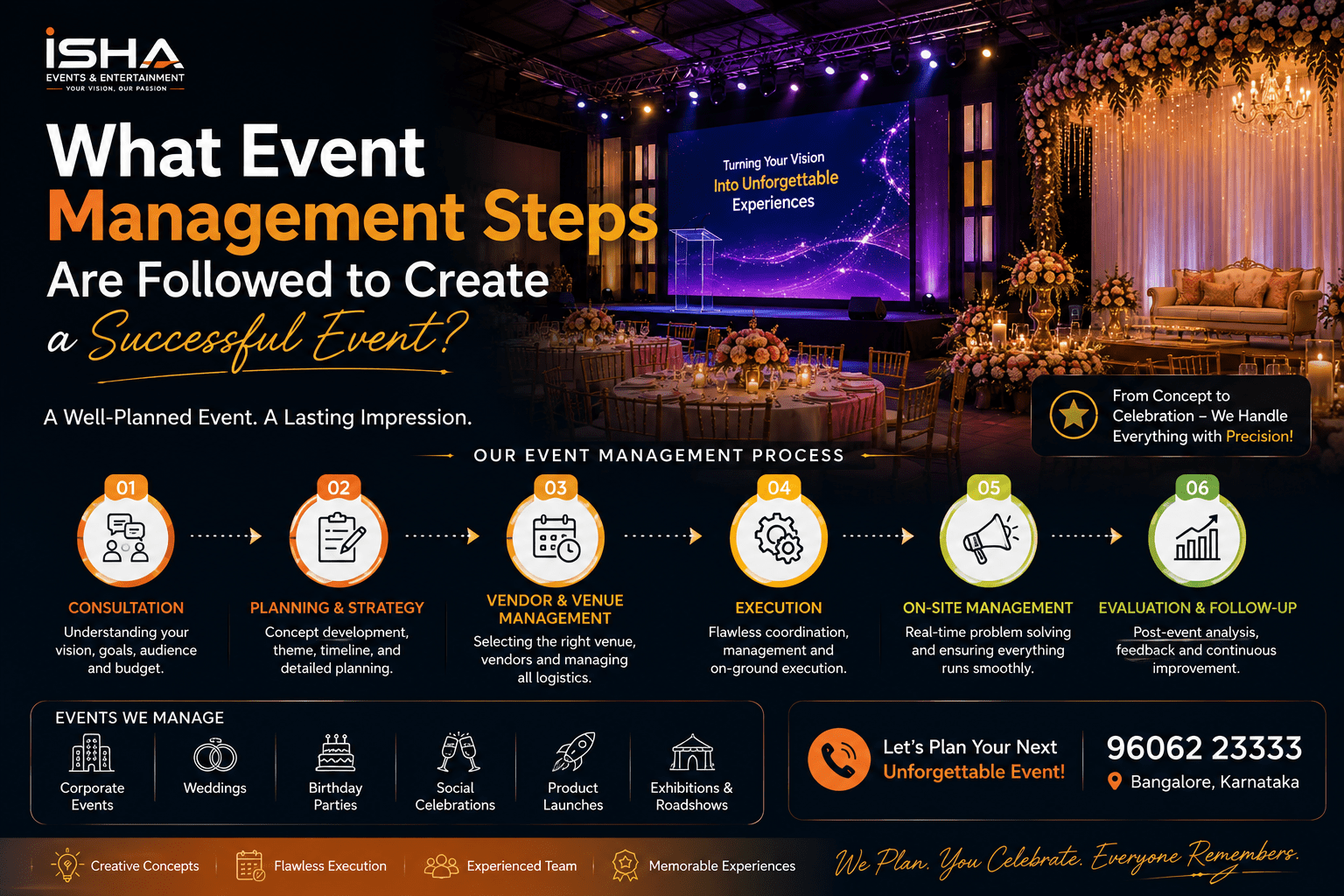
A successful event may look effortless from the outside.
Guests arrive.
The venue looks impressive.
The programme starts on time.
The food is served smoothly.
The entertainment keeps everyone engaged.
Speakers know when to go on stage.
The event ends without major issues.
But behind that smooth experience is a detailed event management process.
From the first planning meeting to the final guest departure, professional event management involves strategy, budgeting, coordination, creativity, logistics and continuous attention to detail.
Whether you are organising a corporate event, wedding, birthday, anniversary, product launch, service launch or private celebration, understanding the event planning process can help you create a better experience.
So, what management steps are followed to create a successful event?
Let’s break down the process.
1. Define the Purpose of the Event
Every successful event starts with a clear objective.
Before choosing a venue or discussing décor, determine why the event is being organised.
For example:
A corporate event may be designed to recognise employees.
A conference may focus on education and networking.
A wedding may bring families together for a meaningful celebration.
A birthday may focus on creating a memorable experience for the guest of honour.
A product launch may introduce a new product to customers, partners or the media.
The purpose influences almost every other decision.
Ask:
What is the main objective?
Who are the guests?
What should they experience?
What should they remember?
What action should they take after the event?
When the objective is clear, planning becomes easier.
2. Understand the Target Audience
An event should be designed around its audience.
A corporate leadership conference should feel very different from a children’s birthday party.
Similarly, a luxury wedding requires a different experience from a casual anniversary celebration.
Consider:
Age group
Professional background
Interests
Expectations
Cultural preferences
Number of guests
Accessibility requirements
Understanding the audience helps determine the venue, food, entertainment, décor, communication and overall event atmosphere.
3. Set a Realistic Budget
Budget is one of the most important parts of event management.
Without a defined budget, expenses can quickly grow.
Start by identifying the total amount available.
Then divide it into major categories such as:
Venue
Catering
Décor
Entertainment
Photography
Sound and lighting
Stage and production
Transportation
Staffing
Branding
Invitations
Miscellaneous expenses
The exact allocation will vary depending on the event.
The important thing is to establish priorities.
A product launch may require greater investment in branding and production.
A wedding may prioritise décor, catering and hospitality.
A birthday may allocate more towards entertainment and theme design.
4. Select the Right Venue
The venue is more than a location.
It influences the entire event experience.
Consider:
Guest capacity
Accessibility
Parking
Seating
Stage requirements
Power supply
Catering facilities
Vendor access
Setup time
Technical infrastructure
Indoor or outdoor requirements
Weather considerations
The venue should match the event’s purpose, guest count and budget.
A beautiful venue that cannot accommodate your technical or logistical requirements may create problems later.
5. Develop the Event Concept
Once the basic requirements are clear, develop the event concept.
This is where creativity enters the process.
The concept may include:
Theme
Colour palette
Décor style
Stage design
Lighting
Entertainment
Guest experience
Branding
Activities
For a corporate event, the concept may be built around the company’s brand.
For a birthday, it could reflect the person’s personality.
For a wedding, it could combine traditional and contemporary elements.
For a product launch, the concept should support the product’s positioning.
A strong concept gives the entire event a consistent identity.
6. Create a Detailed Event Timeline
An event without a timeline is difficult to control.
Create a schedule covering the entire process.
This can include:
Planning → Vendor Booking → Venue Preparation → Décor Setup → Technical Setup → Rehearsal → Guest Arrival → Main Programme → Entertainment → Closing → Dismantling
The event-day programme should also include specific timings.
For example:
Guest arrival
Registration
Welcome
Opening
Speeches
Product presentation
Entertainment
Dinner
Closing
Every key activity should have an owner and a time.
7. Select and Coordinate Vendors
Most events require several external suppliers.
Depending on the event, these may include:
Decorators
Caterers
Photographers
Videographers
DJs
Live performers
Anchors
Sound engineers
Lighting technicians
Stage fabricators
Transportation providers
Security
Event staff
Vendor selection should consider quality, reliability, availability and budget.
Once selected, every vendor should understand:
Scope of work
Setup time
Venue rules
Deliverables
Payment terms
Contact person
Event schedule
This prevents confusion later.
8. Plan Décor and Visual Elements
Décor creates the first visual impression.
But good event décor isn’t about simply adding more decorations.
It should support the overall concept.
Depending on the event, décor can include:
Entrance design
Stage backdrop
Floral arrangements
Lighting
Table décor
Photo zones
Branding
Signage
Themed installations
The strongest décor usually has a clear visual direction.
Everything should feel like it belongs to the same event.
9. Plan Catering and Guest Hospitality
Food is often one of the most discussed parts of an event.
Catering should be planned according to:
Guest count
Event duration
Type of event
Menu preferences
Dietary requirements
Service style
Venue facilities
Corporate events may require buffet or structured meal services.
Weddings may involve elaborate menus.
Birthday parties may need snacks and interactive food stations.
Guest hospitality should also cover seating, reception, assistance and information.
10. Arrange Entertainment
Entertainment can influence the energy of the event.
Options may include:
DJ
Live band
Singer
Dance performance
Anchor
Games
Interactive activities
Celebrity performance
Cultural performances
Special appearances
Entertainment should match the audience and event objective.
A corporate conference does not need the same entertainment format as a birthday party.
The key is relevance.
11. Manage Sound, Lighting and Technical Production
Technical production can make or break an event.
Important requirements may include:
Microphones
Speakers
Projectors
LED screens
Stage lighting
Ambient lighting
Presentation systems
Music playback
Power backup
Technical operators
A technical rehearsal should ideally happen before guests arrive.
Test the microphone.
Check the presentation.
Test the video.
Check the lighting.
Confirm the music cues.
These simple checks can prevent major event-day problems.
12. Manage Guest Invitations and Registration
Guest management begins before the event.
Depending on the event, this may involve:
Invitations
RSVP management
Registration
Guest lists
Seating plans
Welcome desks
Badges
Entry management
Corporate events may require structured registration.
Weddings may need guest hospitality.
Private events may use digital invitations and simple check-in systems.
The process should be easy for the guest.
13. Plan Branding and Communication
For corporate events and product launches, branding is particularly important.
Branding can appear through:
Stage backdrops
LED screens
Welcome boards
Signage
Registration desks
Photo walls
Presentation screens
Promotional displays
Brand visibility should feel integrated into the event rather than randomly placed.
The event should communicate the brand consistently.
14. Prepare a Contingency Plan
No matter how carefully an event is planned, unexpected situations can happen.
A professional event team should consider potential risks.
Examples include:
Rain
Vendor delays
Technical failure
Power issues
Transportation delays
Guest changes
Programme delays
Equipment problems
Medical emergencies
For outdoor events, weather planning is particularly important.
For technical events, backup equipment can be valuable.
For large events, emergency contacts and escalation procedures should be clearly defined.
Good event management isn’t about assuming nothing will go wrong.
It’s about being prepared when something does.
15. Conduct a Final Rehearsal
Before guests arrive, the team should conduct a final walkthrough.
Check:
Venue
Is the layout ready?
Décor
Is everything installed?
Technical
Are sound, lights and screens working?
Catering
Is the food service ready?
Entertainment
Are performers prepared?
Guest Management
Is registration ready?
Programme
Does everyone know their timings?
This final check can reveal problems while there is still time to fix them.
16. Execute the Event
This is where the planning becomes reality.
The event management team should monitor:
Schedule
Vendors
Guest movement
Technical production
Catering
Entertainment
Speakers
Programme transitions
Unexpected issues
The host should not have to run around solving operational problems.
The event management team should take responsibility for coordination.
17. Monitor the Guest Experience
A successful event isn’t measured only by whether the schedule was completed.
Ask:
Are guests comfortable?
Can they find their seats?
Can they hear the speakers?
Is food accessible?
Is the registration process smooth?
Is the entertainment appropriate?
Are there long waiting periods?
Guest experience should remain a priority throughout the event.
18. Handle Last-Minute Changes Professionally
Events rarely follow the original plan perfectly.
A speaker may arrive late.
A performer may need a schedule change.
A presentation may require an update.
A guest count may change.
Weather may affect an outdoor setup.
Professional event management requires flexibility.
The goal is not to panic when something changes.
The goal is to adjust without allowing the audience to feel the disruption.
19. Close the Event Properly
The event doesn’t end when the final speech finishes.
The team may still need to manage:
Guest departure
Transportation
Vendor payments
Equipment removal
Venue handover
Décor dismantling
Lost-and-found items
Final inspections
A proper closing process prevents unnecessary issues after the event.
20. Evaluate the Event
After the event, review what happened.
Ask:
Did we achieve the objective?
Did we stay within budget?
What worked well?
What could improve?
Did guests enjoy the experience?
Were there vendor issues?
Were there technical problems?
What should be changed next time?
For corporate events, feedback can be particularly useful.
Event management is an ongoing learning process.
The Role of Bengaluru Production House in Event Management
Bengaluru Production House approaches event planning as a complete process rather than simply arranging individual services.
Whether the requirement is a corporate event, wedding, birthday, anniversary, product launch, service launch or private celebration, every event begins with understanding the client’s objective.
From planning and concept development to venue coordination, décor, entertainment, technical production, vendor management and event-day execution, each element needs to work together.
The objective is to create an experience that feels seamless to the guest while the operational details are handled by the event team.
Because the best event management is often invisible.
Guests don’t see the coordination calls.
They don’t see the vendor schedules.
They don’t see the technical checks.
They don’t see the contingency planning.
They simply experience a well-organised event.
A Simple Event Management Checklist
Before the event, make sure you have considered:
Event objective
Target audience
Budget
Guest count
Venue
Theme and concept
Décor
Catering
Entertainment
Sound and lighting
Photography and videography
Invitations
Guest management
Branding
Vendor coordination
Transportation
Event timeline
Rehearsal
Emergency contacts
Contingency plan
Event-day coordination
Post-event evaluation
Final Thoughts
A successful event doesn’t happen by accident.
It happens when hundreds of details are planned, coordinated and executed with purpose.
The venue matters.
The décor matters.
The food matters.
The entertainment matters.
But the coordination between all of them matters even more.
That is why professional event management can be valuable.
A good event planner doesn’t simply ask, “What should we arrange?”
They ask:
“What experience are we trying to create, and how do we make every element support it?”
When the strategy is right, the budget is controlled, the vendors are coordinated, the team is prepared and the execution is disciplined, an ordinary event can become an experience people remember.
And that is ultimately what successful event management is about.
Plan with purpose. Coordinate with precision. Execute with confidence.
Frequently Asked Questions
1. What are the most important steps in event management?
The key steps include defining the objective, setting a budget, selecting the venue, developing the concept, planning the timeline, coordinating vendors, arranging décor and entertainment, managing guests, preparing technical requirements, executing the event and evaluating the outcome.
2. Why is event planning important?
Event planning helps organise the different people, vendors, resources and activities involved in an event. It reduces confusion and makes it easier to manage the event efficiently.
3. How early should an event be planned?
The ideal planning timeline depends on the event size and complexity. Large weddings, corporate events and product launches generally require more advance planning than small private celebrations.
4. What does an event management company do?
An event management company can coordinate planning, venue, décor, vendors, entertainment, catering, technical production, guest management, logistics and event-day execution depending on the agreed scope.
5. Why is a contingency plan important?
Unexpected issues can happen during events. A contingency plan provides backup solutions for problems such as weather changes, technical failures, vendor delays and schedule changes.
6. How important is the event budget?
Budget is fundamental because it determines which venues, vendors, services and production elements can be considered. Proper budgeting also helps prevent unexpected expenses.
7. What makes an event successful?
A successful event generally achieves its objective while providing a smooth and enjoyable experience for guests. Good planning, communication, coordination and execution all contribute to the outcome.
8. Does Bengaluru Production House manage different types of events?
Yes. Bengaluru Production House can support corporate events, weddings, birthdays, anniversaries, product launches, service launches and other customised events.
9. Should I hire an event planner for a small event?
It depends on the complexity of the event and how much responsibility you want to handle yourself. Even smaller events can benefit from professional coordination when multiple vendors or detailed arrangements are involved.
10. What should I discuss with an event planner during the first meeting?
Discuss your event objective, date, venue, guest count, budget, theme or concept, required services and expectations for the event experience. This gives the planner a clear foundation for developing the event plan.
Planning your next event in Bangalore?
Don’t leave success to chance.
Start with a clear objective, build a smart plan and let an experienced team coordinate the details.
Bengaluru Production House — where planning meets creativity, coordination and execution.